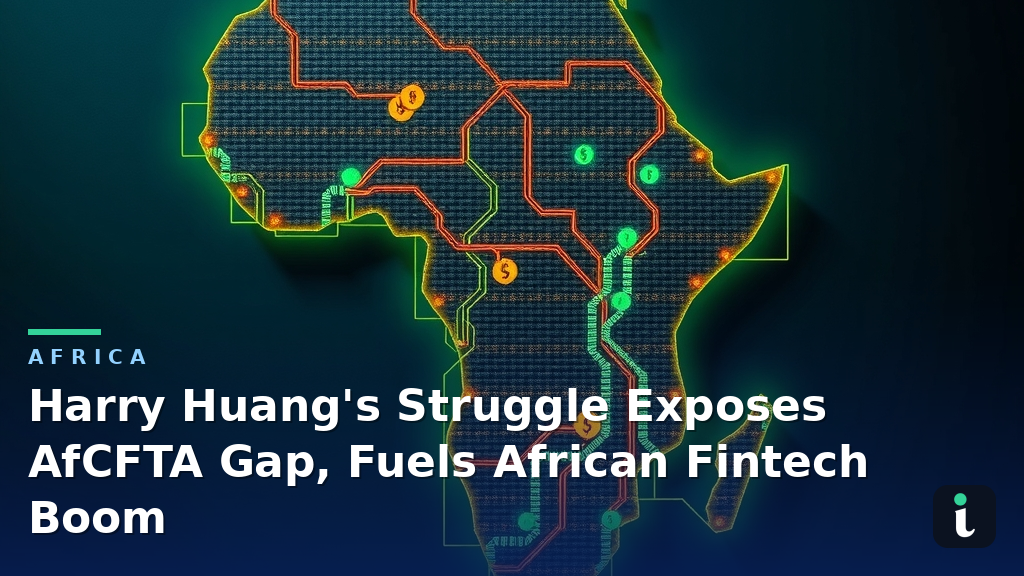
Harry Huang's Struggle Exposes AfCFTA Gap, Fuels African Fintech Boom
The personal experience of a South African entrepreneur highlights how Africa's formal free trade ambitions are missing the mark on existing informal networks, creating a ripe environment for fintech solutions to payment pain points.

Key takeaways
- Informal cross-border trade, like Harry Huang's family business, faces high costs and delays due to inefficient payment systems.
- Africa's formal free trade agreements, such as AfCFTA, often overlook these existing informal networks, creating a demand for new solutions.
- Fintech innovation is booming across the continent, driven by the need to address these payment inefficiencies and high mobile penetration.
- Global market volatility and the rise of digital currencies like Bitcoin ($57,861.78) offer both opportunities and risks for cross-border transactions.
- While fintech offers solutions, systemic challenges like regulatory fragmentation and capital controls remain significant hurdles for large-scale efficient money movement.
The global financial markets are flashing red, with the S&P 500 down 3.70% and the Nasdaq plunging 5.28%. This kind of volatility typically tightens trade flows and makes efficient money movement even more critical, especially in emerging markets. Against this backdrop, a young entrepreneur named Harry Huang is tackling a problem his family knows all too well: the friction of moving money across African borders.
Huang's experience, rooted in his family's import-export business in South Africa, reveals a fundamental disconnect. His parents regularly dealt with suppliers and customers beyond South Africa's borders, encountering firsthand the inefficiencies and high costs of traditional cross-border payments. This personal insight is now driving his entrepreneurial efforts, aiming to develop fintech solutions for a challenge that is far more widespread than many formal policy discussions acknowledge.
$57,861.78: The Price of Bitcoin and the Alternative
Bitcoin currently trades at $57,861.78, with Ether at $1,638.75. These figures aren't just market data; they represent a significant, albeit volatile, alternative to traditional payment rails. For traders like Huang's family, or even informal merchants moving goods between Lagos and Accra, the allure of faster, potentially cheaper transactions through digital currencies can be strong. However, this also comes with risks. As we reported in Chinese National Arrested in Bangkok Over $75M International Crypto Money Laundering Network, unregulated crypto movements can be exploited for illicit activities, highlighting the need for robust, regulated solutions.
3.70%: Global Headwinds and Local Solutions
The S&P 500's 3.70% drop, alongside a 5.28% fall in the Nasdaq, signals a challenging global economic environment. When global markets are turbulent, foreign exchange volatility increases, and access to traditional credit lines can become more difficult. This directly impacts African businesses, including those in Nigeria, that rely on international trade. For an importer in Lagos, this could mean higher costs for raw materials or longer delays in receiving payments from customers in other African countries. The need for efficient payment solutions becomes even more pressing when every percentage point of cost or delay eats into already thin margins.
Africa's Free Trade Area is Overlooking the Traders Who Already Link Its Markets
This headline from Moneyweb cuts to the heart of the issue. While the African Continental Free Trade Area (AfCFTA) aims to boost intra-African trade, its implementation often struggles with practicalities. Formal agreements, while crucial for macro-level integration, frequently overlook the intricate, often informal, networks of traders who already connect African markets. These are the small and medium-sized enterprises (SMEs) and individual entrepreneurs who form the backbone of cross-border commerce, yet face significant hurdles from diverse regulatory environments, capital controls, and currency fluctuations. Harry Huang's story is a perfect illustration of this oversight; his family's business wasn't waiting for a free trade agreement to move goods across borders, but they were certainly feeling the pain of inefficient financial infrastructure.
Fintech innovation has surged across Africa, driven by high mobile penetration and the clear need to address gaps left by traditional banking services. This isn't just about remittances; it's increasingly about trade. When formal systems are slow and expensive, entrepreneurs like Huang step in to build alternatives. The challenge, however, is immense. While TechCabal focuses on Huang's entrepreneurial drive, Moneyweb broadens the perspective, arguing that policy needs to catch up with these existing traders. This isn't a disagreement on facts, but a difference in scope: one highlights individual initiative, the other, systemic policy gaps.
| Payment Challenge | Traditional Systems | Fintech Solutions (Goal) |
|---|---|---|
| Cost | High fees, hidden charges | Lower transaction costs, transparent pricing |
| Speed | Days to weeks | Real-time or near real-time |
| Accessibility | Bank account dependent, limited hours | Mobile-first, 24/7 access, wider reach |
| Transparency | Opaque tracking | Clear transaction visibility |
What This Means for African Trade
For a Nigerian importer dealing with a supplier in South Africa, the current system often means paying hefty bank charges and waiting days for funds to clear. This ties up capital and adds risk. Fintech solutions, like those Harry Huang is likely developing, aim to streamline this. By leveraging new technologies, these platforms can reduce transaction costs and speed up settlement times. This directly benefits SMEs and informal traders who are currently 'overlooked' by formal trade policies, as Moneyweb points out. It also creates opportunities for fintech companies and innovators, and presents a challenge for governments and policymakers to adapt regulatory frameworks to support these innovations without stifling them.
However, it's important to acknowledge the counter-argument: individual fintech solutions, no matter how innovative, cannot fully overcome systemic challenges. Regulatory fragmentation across 54 African nations, varying capital controls, and political instability are significant hurdles. For instance, while a fintech might make a payment faster, it can't magically resolve a currency devaluation or a sudden border closure. These larger issues still dictate the ultimate efficiency of cross-border money movement. The long-term impact of global market volatility, like the current S&P 500 downturn, also remains an unknown, potentially affecting investment into African fintechs and trade infrastructure.
The bottom line
Harry Huang's personal story underscores a critical truth: the real engine of African cross-border trade often runs on informal networks, and the pain points within these networks are a powerful catalyst for fintech innovation. While formal agreements like AfCFTA are essential, the numbers show that practical, grassroots solutions are filling the immediate gaps, demanding that policymakers pay closer attention to the traders who already link the continent's markets. What we need to watch next are further details on Huang's company, how AfCFTA adapts to these realities, and investment trends in African cross-border payment solutions.
Sources: TechCabal — Huang: The boy who moved between China and South Africa wants to make Africa’s money move · Moneyweb — Africa’s free trade area is overlooking the traders who already link its markets · The Africa Report — Death penalty in Africa: Burkina Faso brought it back – who could be next?
For Information Purposes Only. Not Investment Advice. How we work

Iboro William
Iboro William is the founder and editor of Iboro Finance and the builder behind FolioStack, a family of money apps: Samba for airtime, data and bills with Bitcoin cashback, the FolioTrack portfolio tracker, the FolioTrade crypto trading bot and EkpadFile, unlimited cloud storage with watch parties that bring families and loved ones together.
A data analyst by profession, he works daily with SQL, Snowflake and Power BI, and brings the same habit to his writing: read the numbers first, then draw the conclusion.
He has written five books on crypto, money and personal discipline, read by about 15,000 people in 86 countries. On Iboro Finance he explains markets, the economy and crypto for readers in Nigeria, across Africa and in the diaspora.