Nigeria's 2027 Election Safety: New NYSC Insurance Boosts Corps Member Confidence
The National Youth Service Corps and the Independent National Electoral Commission are enhancing welfare for ad hoc staff in the 2027 polls, aiming to increase participation and mitigate historical security concerns.

Key takeaways
- - The National Youth Service Corps (NYSC) and the Independent National Electoral Commission (INEC) have agreed to provide additional insurance coverage for corps members serving in the 2027 general elections.
- - This move is part of a broader effort by NYSC to strengthen the safety and welfare of corps members, encouraging their participation in electoral duties.
- - Corps members are urged to register for the 2027 elections and activate the 'NYSC emergency response application' for prompt security assistance.
- - Historically, corps members have been crucial ad hoc staff for INEC, but concerns over safety have sometimes deterred participation, making these new measures a strategic attempt to boost confidence.
- - While the insurance aims to address welfare, its effectiveness hinges on visible improvements in on-the-ground security and broader trust in the electoral process.
The short version
- The National Youth Service Corps (NYSC) and the Independent National Electoral Commission (INEC) have agreed to provide additional insurance coverage for corps members serving in the 2027 general elections.
- This move is part of a broader effort by NYSC to strengthen the safety and welfare of corps members, encouraging their participation in electoral duties.
- Corps members are urged to register for the 2027 elections and activate the 'NYSC emergency response application' for prompt security assistance.
- Historically, corps members have been crucial ad hoc staff for INEC, but concerns over safety have sometimes deterred participation, making these new measures a strategic attempt to boost confidence.
- While the insurance aims to address welfare, its effectiveness hinges on visible improvements in on-the-ground security and broader trust in the electoral process.
The detail
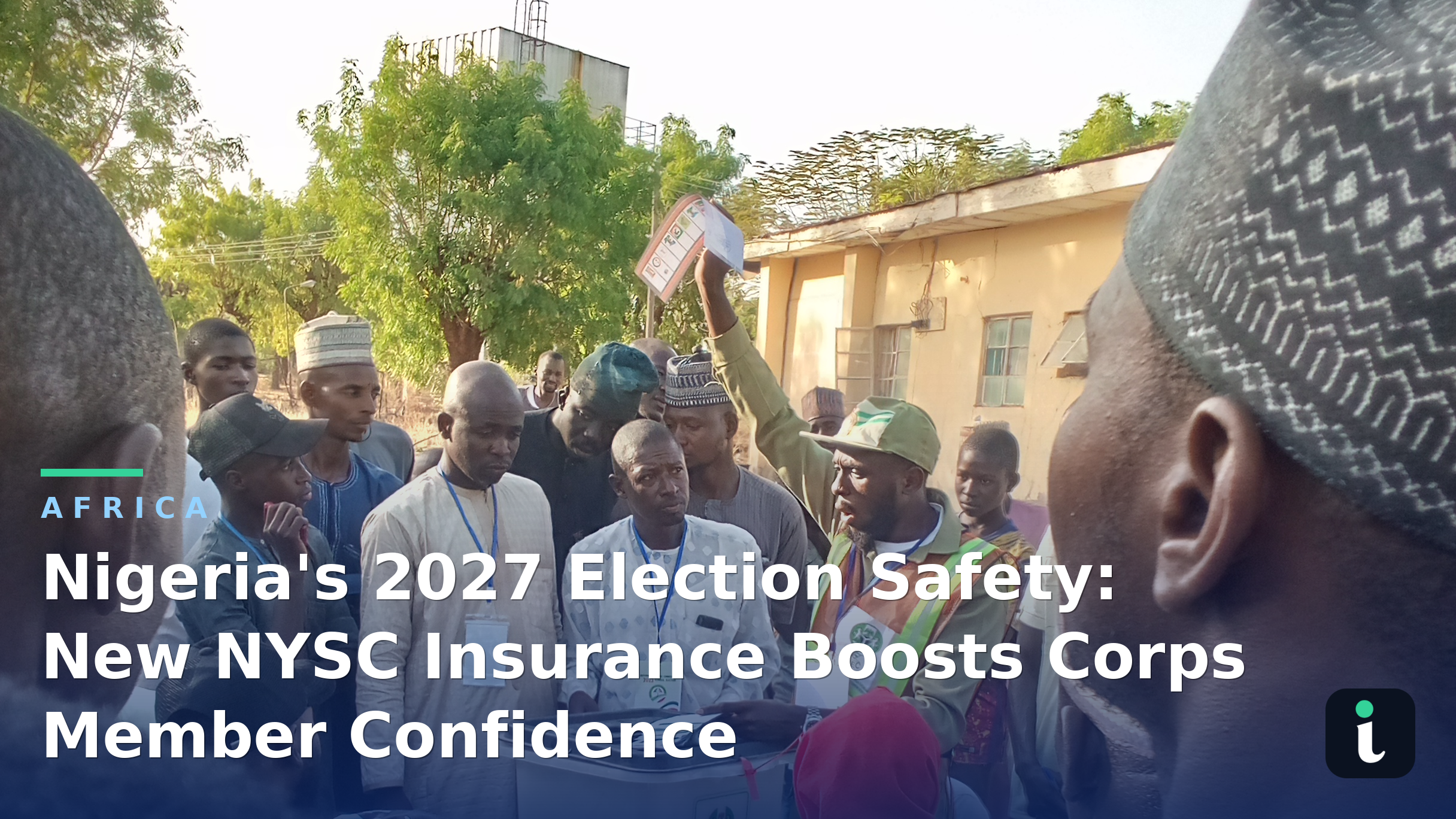
Nigeria's 2027 general elections are still over a year away, but preparations are already underway, focusing on the crucial role of youth. The National Youth Service Corps (NYSC) and the Independent National Electoral Commission (INEC) have now finalized an agreement for additional insurance coverage for corps members who will serve as ad hoc electoral staff. This decision, announced by NYSC Director-General Brigadier General Olakunle Nafiu, aims to bolster the safety and welfare of these young Nigerians. Nafiu described the arrangement as central to the scheme's efforts to protect corps members deployed for electoral duties.
Speaking at an orientation camp in Kogi State, Nafiu encouraged corps members to register for the 2027 elections, assuring them of NYSC's collaboration with relevant security agencies. He also highlighted the 'NYSC emergency response application', noting its role in enhancing security agencies' capacity for prompt emergency responses. The Director-General framed electoral participation as a civic duty, a way for corps members to contribute to national development and reciprocate the nation's investment in their tertiary education. Mrs Chika Chris-Moneke, the NYSC State Coordinator in Kogi, confirmed that 2,540 corps members had registered at the Asaya Orientation Camp for the 2026 Batch ‘C’ Stream II Orientation Exercise, comprising 1,166 males and 1,374 females. While Punch Business provided extensive details and direct quotes, Nairametrics offered only a brief headline confirming the agreement, lacking the context and specific safety measures.
Why this matters for 2027 NYSC participation
This new insurance coverage is more than just a financial perk; it's a strategic move to address a persistent challenge in Nigeria's electoral process: securing enough motivated, reliable ad hoc staff. Corps members have long been the backbone of INEC's field operations, leveraging their national distribution and educational background. However, past elections have frequently been marred by security issues, leading to genuine fears among corps members and their families. These fears have, at times, led to reluctance to participate, impacting the availability of personnel for critical electoral duties.
The mechanism here is straightforward: reduce perceived risk, increase willingness to participate. By providing additional insurance, NYSC and INEC are attempting to lower the psychological barrier for young graduates. This isn't just about financial compensation after an incident; it's about signaling a commitment to welfare that might encourage higher participation rates. A larger, more confident pool of ad hoc staff could lead to smoother election administration and potentially enhance the integrity of the process by ensuring sufficient, motivated personnel at polling units. For parents and guardians, this could offer some reassurance, easing their concerns about their children's safety during what can be a volatile period.
This initiative also aligns with broader governmental preparations for the 2027 polls. As we reported earlier, President Tinubu has already proposed six new electoral officials for INEC ahead of the elections, indicating a comprehensive approach to strengthening the electoral body. Such measures, combined with enhanced corps member welfare, suggest a concerted effort to build confidence in the upcoming polls. The success of this model could even serve as a blueprint for other African nations that rely on youth for civic duties in potentially challenging environments.
The limits of insurance in securing elections
While additional insurance is a welcome development, it's critical to consider its limitations. The strongest counter-argument against this move significantly boosting participation and safety is that financial incentives or post-incident coverage alone may not address the root causes of insecurity or the deep-seated fears stemming from past election violence. Many corps members' reluctance isn't just about financial risk; it's about the perceived physical danger and the lack of immediate security in volatile areas. An insurance payout, while helpful, doesn't prevent an incident from happening.
Without visible, on-the-ground improvements in security infrastructure – such as clear deployment strategies for security agencies and tangible reductions in electoral malpractice – the impact of this insurance might be blunted. The exact nature and deployment strategy of the 'relevant security agencies' collaborating with NYSC and INEC remain largely unknown. Similarly, the effectiveness and widespread adoption of the 'NYSC emergency response application' in real-world election scenarios are untested. If corps members don't feel safer, or if the security response is not demonstrably swift and effective, the insurance might only offer a limited psychological boost. The specific details of the 'additional insurance coverage', such as the sum assured or scope of coverage, are also yet to be fully disclosed, which will ultimately determine its perceived value.
What we need to watch next are further announcements from NYSC or INEC detailing the specifics of the insurance policy, which should be expected in late 2026 or early 2027. We should also look for reports or statements from security agencies regarding their operational plans for the 2027 elections. Any surveys or feedback from corps members during subsequent orientation exercises, particularly their perception of safety for electoral duties, will be a key indicator of whether these measures are truly shifting confidence. Finally, any pilot programs or trials of enhanced security measures before the main 2027 elections would offer concrete evidence of their potential impact.
Ultimately, the success of this initiative hinges on translating policy into tangible security on the ground. For the Nigerian electorate, this means potentially smoother election administration, but for corps members, it means trusting that the system has truly prioritized their safety beyond a financial promise. The upcoming months will reveal whether these proactive steps are enough to overcome historical anxieties and genuinely secure the participation of Nigeria's youth in its democratic process.
Frequently asked questions
What is the new agreement about 2027 NYSC election duties?
The National Youth Service Corps (NYSC) and the Independent National Electoral Commission (INEC) have agreed to provide additional insurance coverage for corps members serving as ad hoc staff in the 2027 general elections. This is part of NYSC's efforts to enhance the safety and welfare of corps members.
Why is additional insurance being provided for corps members in 2027 polls?
The additional insurance aims to strengthen the safety, protection, and welfare of corps members deployed for electoral duties. Historically, security concerns have deterred some corps members from participating, and this measure seeks to boost their confidence and encourage higher participation rates, improving the availability of personnel for the 2027 elections.
Will new security measures significantly increase corps member participation in 2027 elections?
While the additional insurance and emphasis on security collaboration aim to reduce perceived risks, their effectiveness is still an unknown. Without visible, on-the-ground improvements in security infrastructure and a tangible reduction in electoral malpractice, financial incentives alone might not be enough to overcome deep-seated fears from past election violence.
Sources: Punch Business — 2027: NYSC, INEC agree extra insurance cover for corps members · Nairametrics — NYSC, INEC agree additional insurance cover for Corps Members ahead of 2027 elections
For Information Purposes Only. Not Investment Advice. How we work

Iboro William
Iboro William is the founder and editor of Iboro Finance and the builder behind FolioStack, a family of money apps: Samba for airtime, data and bills with Bitcoin cashback, the FolioTrack portfolio tracker, the FolioTrade crypto trading bot and EkpadFile, unlimited cloud storage with watch parties that bring families and loved ones together.
A data analyst by profession, he works daily with SQL, Snowflake and Power BI, and brings the same habit to his writing: read the numbers first, then draw the conclusion.
He has written five books on crypto, money and personal discipline, read by about 15,000 people in 86 countries. On Iboro Finance he explains markets, the economy and crypto for readers in Nigeria, across Africa and in the diaspora.