ODM Fissures: Post-Raila Power Vacuum Threatens Kenya's Stability, Shilling
Public discord between Nairobi Senator Edwin Sifuna and Embakasi East MP Babu Owino highlights a significant power struggle within Kenya's ODM, signaling a leadership vacuum after Raila Odinga's diminished influence and sparking concerns about political stabi…

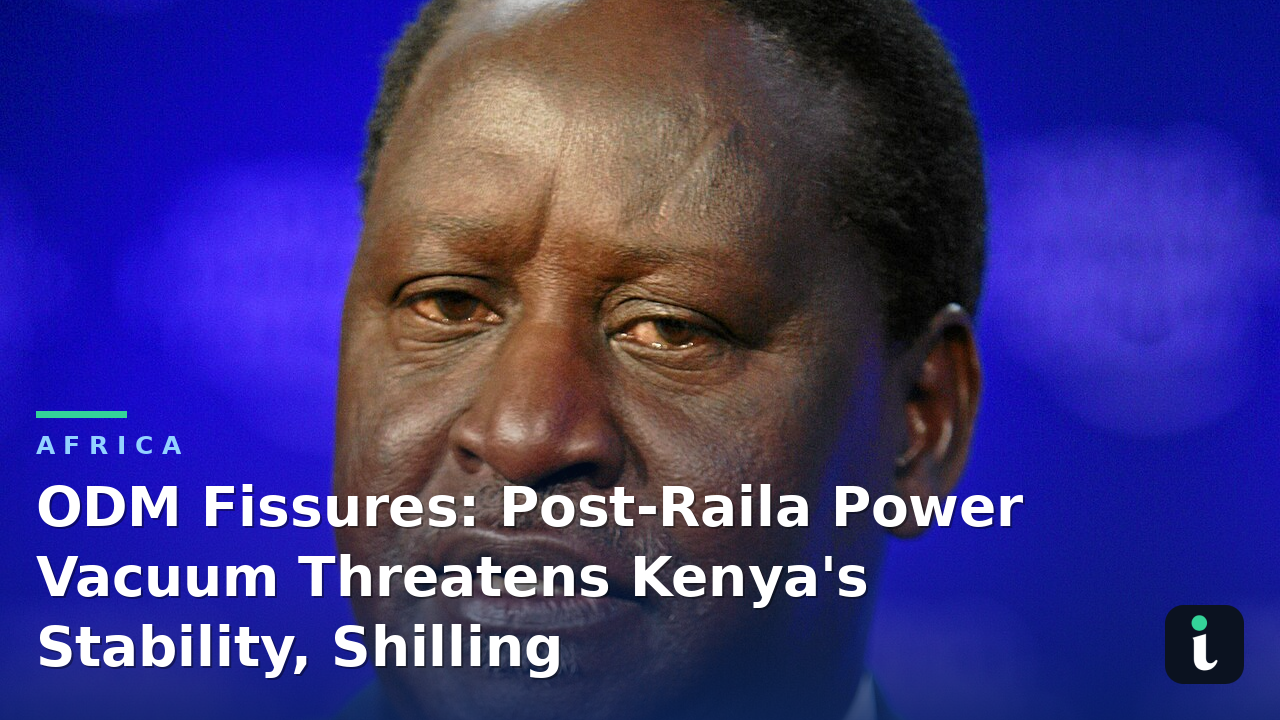
Key takeaways
- Nairobi Senator Edwin Sifuna and Embakasi East MP Babu Owino, once allies, are now openly clashing over future political ambitions, signaling a significant rift within the ODM.
- This internal conflict points to a leadership vacuum within the ODM following Raila Odinga's reduced influence, potentially weakening the opposition's stance ahead of the Kenya 2027 election.
- The Kenyan shilling has reacted to this political uncertainty, with the USD/KES exchange rate rising to 130.00, a +3.45% increase, indicating investor sensitivity to stability concerns.
- While the discord could be tactical, a sustained fragmentation of the ODM would likely benefit the incumbent government and introduce further market volatility for businesses and investors across Africa.
Nairobi Senator Edwin Sifuna and Embakasi East MP Babu Owino, two prominent figures within Kenya's Orange Democratic Movement (ODM), are now publicly at odds. Their disagreement, driven by individual ambitions for key electoral positions, marks a significant internal fissure within the opposition party. This development unfolds against the backdrop of a weakened ODM following veteran politician Raila Odinga's diminished influence, raising questions about the party's cohesion as the Kenya 2027 election draws closer.
This internal fragmentation isn't just a political squabble; it carries real economic implications. On Tuesday, 24 November 2026, the Kenyan shilling (KES) saw a notable movement, with the USD/KES exchange rate climbing to 130.00, a +3.45% increase. This currency shift suggests market sensitivity to political stability, hinting that investors are already factoring in potential uncertainty.
Why ODM's Internal Rift Matters for Kenya's Future
The core of the conflict, as reported by The Africa Report, lies in a clash of 'power and ambition.' Senator Sifuna is reportedly eyeing the presidency, while MP Owino seeks the Nairobi governorship. These are not minor positions; they represent significant political leverage and influence. The fact that these two, once united against President William Ruto and even parts of the ODM establishment, are now openly competing underscores a deeper issue: the absence of a clear, unifying force within the party.
Raila Odinga has long been the gravitational center of the ODM and Kenya's opposition. His 'post-Raila' era, however, appears to have left a void. Without a strong, unchallenged leader to arbitrate disputes or rally factions, individual ambitions can quickly escalate into open rivalries. This dynamic makes it harder for the party to present a united front or develop a coherent strategy for the upcoming 2027 elections.
How the Political Shuffle Impacts Kenyan Markets
Markets dislike uncertainty. The recent movement in the USD/KES exchange rate is a textbook example of this principle. A +3.45% increase to 130.00 against the dollar isn't just a number; it reflects how investors perceive Kenya's political future. When a major opposition party shows signs of internal disarray, it can signal potential instability, which in turn can deter foreign investment and lead to capital outflows.
For an importer in Nairobi, a weaker shilling means higher costs for goods purchased in dollars. Someone in Lagos looking to invest in Kenyan businesses might pause, weighing the political risk against potential returns. This currency movement shows that political developments, even internal party squabbles, have tangible effects on the cost of doing business and the value of savings.
What This Means for Kenyan Voters and Regional Stability
The most immediate losers in this scenario are the ODM establishment and its supporters. A divided house struggles to mount an effective challenge to the incumbent government. For Kenyan voters, this could mean a less cohesive opposition, potentially limiting their choices and the robustness of political debate in the run-up to 2027. President Ruto and the current ruling establishment, conversely, stand to gain from a fragmented opposition.
Beyond Kenya's borders, the stability of a major East African economy influences regional investment flows and political sentiment across the continent. Nigeria and other African nations, often linked through trade and investment, watch these developments closely. A strong, stable Kenya contributes to a more predictable regional environment, while internal strife can introduce ripples of uncertainty.
However, it's worth considering the strongest counter-argument: this public spat might be a tactical maneuver rather than an irreparable split. Political figures sometimes posture to gauge support or gain leverage before ultimately uniting behind a common agenda. The ODM could still consolidate its strength, perhaps under a new, unifying leader, before the 2027 elections.
Unanswered Questions and Potential Risks
The true depth of the fissure between Sifuna and Owino remains an unknown. We don't know who will ultimately secure the ODM's backing for the presidential or gubernatorial bids, nor the full impact this conflict will have on the party's electoral performance. It's also unclear if other political figures might emerge to unify the 'post-Raila' opposition, or what specific policy platforms these aspirants would pursue.
The risk for Kenya is prolonged political uncertainty that could continue to weigh on the shilling and broader economic indicators. For businesses and individuals, this means a higher cost of hedging against currency fluctuations and a more cautious approach to long-term planning. The stakes are high for the upcoming Kenya 2027 election candidates and for the country's economic trajectory.
What to watch
- Further political announcements or rallies by Sifuna and Owino regarding their 2027 ambitions.
- Statements or actions from the ODM establishment concerning internal party leadership and cohesion.
- Any shifts in public opinion polls or political endorsements leading up to the 2027 elections.
- Continued movements in the USD/KES exchange rate and other Kenyan economic indicators, as these reflect investor confidence.
Sources: The Africa Report — Kenya 2027: Sifuna vs Babu Owino – who can turn the crowds into votes? · SCMP Business — Can Hong Kong turn university research into unicorns through venture capital funds?
For Information Purposes Only. Not Investment Advice. How we work

Iboro William
Iboro William is the founder and editor of Iboro Finance and the builder behind FolioStack, a family of money apps: Samba for airtime, data and bills with Bitcoin cashback, the FolioTrack portfolio tracker, the FolioTrade crypto trading bot and EkpadFile, unlimited cloud storage with watch parties that bring families and loved ones together.
A data analyst by profession, he works daily with SQL, Snowflake and Power BI, and brings the same habit to his writing: read the numbers first, then draw the conclusion.
He has written five books on crypto, money and personal discipline, read by about 15,000 people in 86 countries. On Iboro Finance he explains markets, the economy and crypto for readers in Nigeria, across Africa and in the diaspora.