Pete Edochie's Death: Nollywood's Founding Era Fades, Enugu's Cultural Test
The passing of Nollywood titan Pete Edochie at 79 during Enugu's cultural festival highlights a critical moment for Nigeria's creative economy, testing its ability to preserve foundational heritage while embracing new platforms.

Key takeaways
- Veteran actor Pete Edochie died at 79, marking the loss of a foundational figure whose career defined Nollywood's global cultural export.
- His passing occurs as Enugu State hosts the National Festival of Arts and Culture, underscoring the intersection of creative economy and traditional heritage.
- The departure of pioneering icons like Edochie shifts the burden of cultural preservation to younger generations and digital platforms, challenging Nollywood's institutional memory.
- While modern Nollywood thrives on new content, the long-term impact on its unique identity and global positioning without its original torchbearers remains an open question.
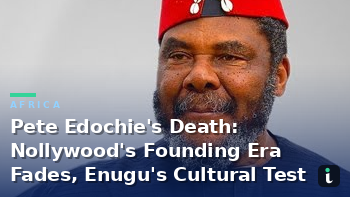
Nollywood veteran Pete Edochie, a figure whose very name became synonymous with Nigerian cinema, died at the age of 79. His son, Leo Edochie, announced the passing, which occurred while Enugu State, a place Edochie frequently called his 'first port of call,' is hosting the National Festival of Arts and Culture. The timing of this loss, acknowledged by Enugu Governor Peter Mbah, casts a long shadow over celebrations of Nigeria's cultural heritage, prompting a deeper look at the industry's evolution.
Edochie wasn't just an actor; he was, as Governor Mbah described, an institution. His breakthrough role in the screen adaptation of Chinua Achebe's 1958 novel, 'Things Fall Apart,' launched him to international prominence, solidifying a visual identity for Nigerian stories and, specifically, Igbo culture. He carried national honors and titles like MON, Ononenyi, and Ogadagidi, reflecting a life deeply intertwined with the cultural fabric of the nation. His career bridged the gap between traditional storytelling and its global cinematic export, making him a direct link to Nollywood's formative years.
If you are a Nollywood creative
For those working in Nigeria's film industry, Edochie's death represents a profound shift. The loss of pioneering figures like him removes a direct institutional bridge to Nollywood's formative era. This means the burden of cultural preservation, of understanding the roots and evolution of Nigerian storytelling on screen, now falls more squarely on younger generations of filmmakers and actors. It's a challenge to maintain the unique identity that Edochie helped establish, especially as the industry increasingly caters to global digital streaming platforms. The question isn't just about recreating his gravitas but understanding the cultural context he brought to his roles, which often involved bringing Igbo language, wisdom, and proverbs to life for international audiences. How will this legacy be taught and embodied without the direct presence of its originators?
If you are a cultural institution or government official
For cultural ministries and state governments, particularly in Enugu and Anambra, Edochie's passing highlights a critical need for formal memorialization and institutional support for the arts. Governor Peter Mbah noted Edochie's lifelong ties with Enugu, despite hailing from Nteje in Anambra State, emphasizing the cross-state impact of his legacy. Nollywood has grown into one of Nigeria's most vital non-oil economic sectors, serving as a major cultural export. The ongoing National Festival of Arts and Culture in Enugu provides a natural, if somber, backdrop for discussions on how to formally document and celebrate the contributions of its founding generation. The challenge is to move beyond tributes to concrete strategies that embed the institutional memory of these pioneers into the sector's future, ensuring that the next wave of creative talent understands and builds upon this rich heritage, rather than simply moving past it.
If you are a fan of African cinema
For audiences across Nigeria, the rest of Africa, and the global diaspora, the death of Pete Edochie means the silencing of a familiar, commanding voice that shaped their understanding of African stories. His performances transcended mere entertainment, preserving aspects of cultural heritage that resonated deeply. While Nollywood's modern commercial success is increasingly driven by contemporary digital platforms and younger filmmakers, the emotional and cultural connection to its founding generation remains strong for many. The counter-argument, that modern Nollywood thrives independently of its founders, holds commercial weight. Yet, for many fans, the authenticity and depth brought by actors like Edochie are irreplaceable. His passing raises questions about how the industry will continue to project a distinct Nigerian identity globally, especially as new narratives and production styles emerge. Will the essence of what made Nollywood unique endure, or will it be diluted in the pursuit of broader appeal?
Questions to ask yourself
- How will Nollywood's current generation integrate the cultural depth and institutional memory of pioneers like Pete Edochie into their contemporary work?
- What formal mechanisms are cultural authorities implementing to preserve the legacy of Nollywood's founding figures beyond immediate tributes?
- Will the increasing global reach of Nollywood through digital platforms dilute or strengthen the unique cultural identity established by its originators like Edochie?
Sources: Punch Business — Enugu gov mourns Pete Edochie, says Nigeria loses a titan · Punch Business — ‘Thanks for your kind encouragement’, Funke Akindele mourns Pete Edochie · Punch Business — Morning Recap: Pete Edochie dies at 79, Omo-Agege rejects court ruling, other top stories · Punch Business — Pete Edochie: Life, career and legacy of a Nollywood legend · Punch Business — Pete Edochie, Olu Jacobs, Sam Loco: Remembering Nollywood’s fallen legends · Nairametrics — Veteran Nollywood actor Pete Edochie dies at 79
For Information Purposes Only. Not Investment Advice. How we work

Iboro William
Iboro William is the founder and editor of Iboro Finance and the builder behind FolioStack, a family of money apps: Samba for airtime, data and bills with Bitcoin cashback, the FolioTrack portfolio tracker, the FolioTrade crypto trading bot and EkpadFile, unlimited cloud storage with watch parties that bring families and loved ones together.
A data analyst by profession, he works daily with SQL, Snowflake and Power BI, and brings the same habit to his writing: read the numbers first, then draw the conclusion.
He has written five books on crypto, money and personal discipline, read by about 15,000 people in 86 countries. On Iboro Finance he explains markets, the economy and crypto for readers in Nigeria, across Africa and in the diaspora.